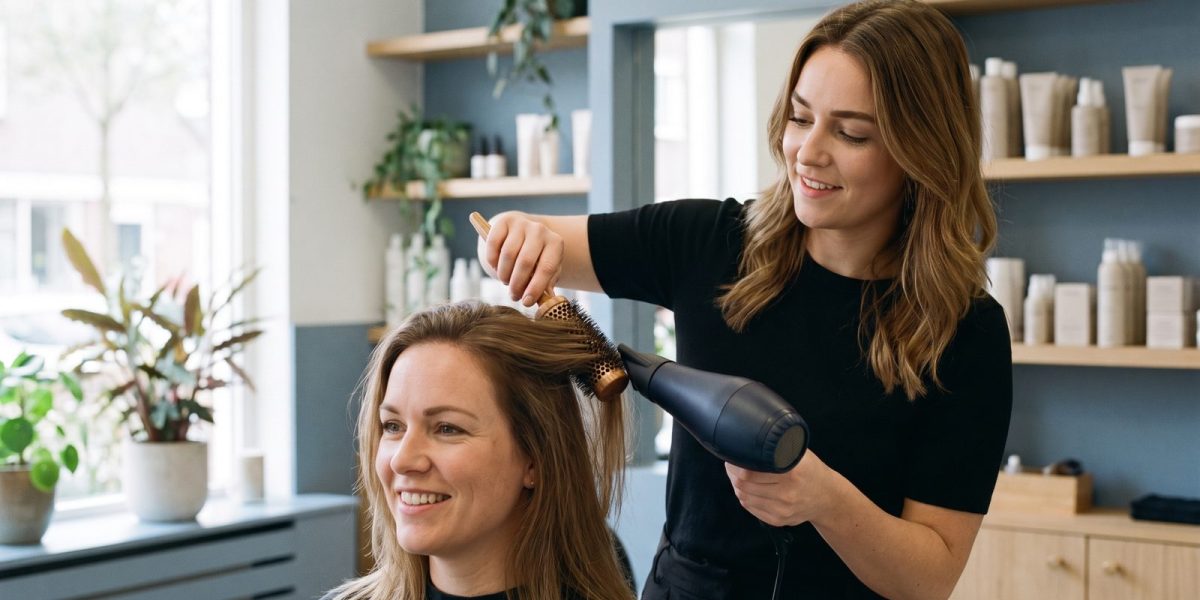
A customer looking for a hairdresser or beauty salon in the Netherlands types the trade plus their town, or “kapper online afspraak maken” (book a hairdresser online) and “kapper in de buurt” (hairdresser nearby). Those are the suggestions Google itself shows. Whoever lands on your website probably wants to know three things above all: what you do, what it costs and when they can come in.
Below is what belongs on the website of a hair or beauty salon, with the rule or guideline behind each point. Where something is a choice rather than a legal duty, we say so. The rules cited are Dutch.
1. A booking button that is always in view
The most important button on your site is the one to your calendar. Put it at the top of every page and let it go straight to the booking screen of your salon software, not to a contact form. Use the same link in your Google Business Profile: under “Booking” you can add a link to your booking page (Google). The ways to take bookings online and how to choose are covered in online booking on your website.
2. Treatments and prices
Customers compare before they book. A clear price list per treatment answers that question. If you have fixed prices for your treatments, you must make them available to customers, for example in the salon or on your website (Dutch Civil Code, articles 6:230b and 6:230c, in Dutch). Putting them online is therefore a choice, but if you do, the rule of the Dutch consumer authority ACM applies: a price for consumers includes VAT and any additional costs, and this is mandatory in every offer (ACM, in Dutch). If the price depends on hair length, say so, with a from-price you can stand behind.
3. Opening hours, address and how to get there
On a phone, a visitor should see at a glance when you are open, where you are and where to park. Keep those details identical to your Google Business Profile. Google writes that businesses with complete and accurate information are more likely to be shown in local searches, and mentions special opening hours too (Google).
4. Photos of your salon, your team and your work
Real photos say more than stock photos. Mind the privacy rules: if customers are recognisable in a photo, that is personal data and you need a legal basis to publish it, for example their consent (Dutch Data Protection Authority, in Dutch). Ask for that consent beforehand, also for before-and-after photos, and keep a note that you have it. If a photo of a skin treatment reveals something about someone’s health, you need explicit consent.
5. Reviews, without rewards
Reviews help in Google: how well known a business is counts towards the local results, and Google looks at, among other things, the number of reviews and positive ratings (Google). So ask for them, but within the rules. Google prohibits rewards for reviews, such as money, discounts or a free treatment, and also selectively asking only satisfied customers (Google). A “discount on your next visit for a review” is therefore not allowed. Do reply to reviews: Google writes that this shows you value the feedback.
If you show reviews on your own site, the ACM rules apply as well: fake reviews are prohibited, and if your reviews look genuine, you explain how you check that they come from real customers (ACM, in Dutch).
6. Memberships and registers you actually have
If you belong to a trade association or are listed in a register, say so and link to it. If your association gives your salon a disputes scheme, such as the Geschillencommissie Uiterlijke Verzorging that ANKO members belong to, it is not a choice: you mention it where you describe your services (Dutch Civil Code, article 6:230b, in Dutch). The Dutch hairdressers’ association ANKO has a public search for member salons (ANKO), and beauty specialists can be listed in the SKIN quality register, which consumers can search by name (ANBOS). Only mention what applies to you.
7. What the law requires on your site
Your registered name and trade name, your Chamber of Commerce (KVK) number, your visiting address (unless you have had it shielded in the Business Register), your email address and phone number, and if you offer services online, also your VAT identification number (Ondernemersplein, in Dutch). Plus a privacy statement. If you use cookies, note the distinction the Dutch Data Protection Authority makes: limited analytics cookies with little or no privacy impact need no consent, tracking cookies do; you ask for that consent before placing them, and scrolling on does not count as consent (Dutch Data Protection Authority, in Dutch).
What does not belong: health questions in a form
A beauty salon sometimes asks about allergies, medication or skin conditions at intake. Data about someone’s health is special category personal data, which you may only process if a legal exception applies (Dutch Data Protection Authority, in Dutch), such as explicit consent (Dutch Data Protection Authority, in Dutch). So do not ask for that information through an ordinary contact form. Discuss it in the salon or, with explicit consent, record it in secure salon software.
The checklist in short
- Booking button at the top of every page, the same link in your Google Business Profile.
- Treatments with prices including VAT and additional costs.
- Opening hours, address and parking, identical to your Business Profile.
- Your own photos, with consent from anyone recognisable.
- Ask everyone for a review, without rewards, and reply to reviews.
- Memberships and registers you actually have.
- Company details with your KVK number, a disputes scheme if you have one, a privacy statement and a correct cookie notice.
Frequently asked questions
Is an Instagram account or Google Business Profile not enough?
They complement each other. Your Business Profile helps you in the map results and Instagram shows your work, but on your own site you decide how your price list, your treatments and your booking button look, and it stays yours.
Do I have to put my prices online?
Not necessarily online. If you have fixed prices, you must make them available to customers, for example in the salon or on your site. If you publish them online, include VAT and additional costs. For customers who want to compare, a clear price list is often the reason to book with you.
What does a website for a salon cost?
With us, a Starter website costs €3,450 one-off: up to 5 pages, a responsive custom design, contact form and Google Maps, basic SEO, cookie consent and privacy policy, and 30 days of support. Hosting and domain are not included in the build price. See our business websites.
Where to start
Open your own site on your phone and count how many taps it takes to book an appointment. The fewer taps, the better. To see what else can be improved, scan your homepage for free, or tell us what kind of salon you run and which software you use.